

Yelp for Restaurants: How to Get More Reviews Without Getting Filtered
Why Yelp hides so many restaurant reviews, how the recommendation software actually decides, and eight strategies that work with the algorithm instead of against it.
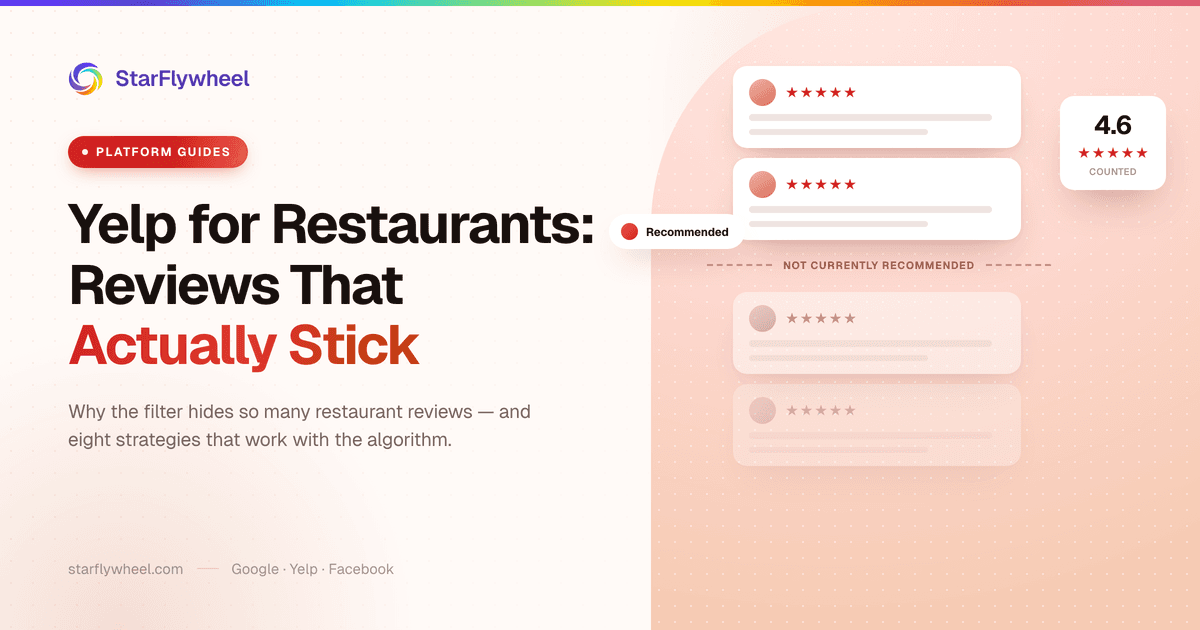
Your Reviews Are Not Gone. They Are in the Basement.
Every restaurant owner has had this week. Four customers tell you, to your face, that they left you a glowing Yelp review. You check the page. Nothing. Your count has not moved and your rating has not budged, and somewhere between their phone and your profile, four genuine reviews evaporated.
They did not. They are sitting at the bottom of your page behind a grey link that reads something like "other reviews that are not currently recommended," and almost nobody clicks it. They are still public, still readable, and completely irrelevant, because reviews in that section do not count toward your star rating.
This is the single most common complaint restaurant owners have about Yelp, and it is worth understanding properly, because the strategies that work on Google actively backfire here. Yelp restaurant reviews follow different rules — including one rule that reverses everything you have been told about asking. For the general playbook, see our guide on how to get more Yelp reviews; this piece is specifically about restaurants and the filter.
Why Yelp Still Matters for Restaurants
It is tempting, after a month of vanishing reviews, to write Yelp off entirely. That would be a mistake for a restaurant specifically, for three reasons.
Yelp is still a discovery engine for dining. People searching for a plumber usually go to Google. People deciding where to eat tonight — particularly in a city, particularly travelers — still open Yelp with intent to choose, not to research. That is a diner much further down the funnel than someone idly browsing.
Yelp reviews are longer and more specific. The culture of the platform rewards detail. A Yelp review names the dish, describes the room, and mentions the server; a Google review says "great food." For a restaurant, where the decision is emotional and specific, that depth does real persuasive work.
Your page ranks whether you tend it or not. Your Yelp listing exists and shows up in search results regardless of whether you ever log in. The only question is whether the version diners find is one you shaped.
How the Filter Actually Works
Yelp does not call it a filter. Internally it is recommendation software, and it runs automatically on every review, continuously — meaning a review can be recommended today and not recommended next month, or the reverse, with nobody touching anything.
What it is weighing, broadly, is how much it can trust the account rather than the content:
- Account history. How long has this person been on Yelp, and have they reviewed other businesses?
- Activity. Do they have a profile photo, friends, check-ins, uploaded photos — the marks of a real user rather than an account created ten minutes ago?
- Pattern. A first-ever review that is five stars for a single business looks, statistically, exactly like a solicited or fake review. The software cannot tell the difference between your delighted regular and a favor.
- Clustering. Several reviews arriving from the same device or network in a short window is a strong negative signal.
Two myths are worth killing here. The first is that Yelp deletes reviews — it does not; it reclassifies them, and they remain visible to anyone who looks. The second, more persistent one is that Yelp filters your good reviews to pressure you into advertising. Yelp denies this categorically, and the lawsuits alleging it have not succeeded in establishing it. More practically: even if you believe it, you cannot act on it. The only lever you actually control is the quality of the accounts reviewing you.
Why Restaurants Get Hit Hardest
The Yelp review filter for restaurants is not tuned against you specifically. Restaurants simply have the worst possible customer profile for it.
Think about who eats at your restaurant. Tourists passing through once. A couple on a first date from two suburbs over. A family celebrating a birthday who will not be back until next year. These are exactly the people most likely to download Yelp in the parking lot, create an account, write one enthusiastic review about one restaurant, and never open the app again.
To the recommendation software, that is indistinguishable from a fake. A dentist or a plumber gets reviewed by locals with longer relationships and more established accounts. You get reviewed by strangers having one wonderful night. Your best reviews come from your least established reviewers, and that is the whole problem in one sentence.
Eight Strategies That Work With the Algorithm
1. Do Not Ask Customers to Review You on Yelp
This is the one that surprises people, so it goes first. Yelp's terms explicitly prohibit businesses from soliciting reviews — not discouraged, prohibited. Google actively encourages you to ask; Yelp will put a consumer alert on your page for it. Beyond the policy, it is self-defeating: a solicited review from a new account is the exact pattern the software filters. You may absolutely ask for feedback, and you may point people to a page where Yelp is one option among several. You may not ask for a Yelp review.
2. Focus on Your Regulars
Your regulars are more likely to have real Yelp histories — accounts with friends, photos, and a trail of other reviews. A review from an established account sticks. Rather than chasing volume from one-time diners, make your regulars aware that your Yelp page exists and is worth visiting. They will find their own way to the review button.
3. Claim and Complete Your Business Page
Free, one afternoon, and the highest-leverage thing on this list. Claim the page, then fill it: real hours, current menu, and a lot of photographs. Yelp is unusually visual for a restaurant category, and a complete page attracts more organic traffic — which produces more organic reviews from people who arrived under their own steam, which is precisely the kind the filter likes.
4. Respond to Every Review
Respond to all of them, recommended or not, positive and negative. Public responses signal an active business to diners deciding between you and the place across the street. Keep the negative ones short and warm — our guide on responding to negative reviews has templates, including one written for restaurants.
5. Put a Yelp Badge on Your Website
Yelp provides badges and widgets for exactly this. Sending your own web traffic to your Yelp page produces organic visits from people who chose to go, which is the cleanest possible signal.
6. Use QR Codes That Point to a Choice, Not to Yelp
A table tent linking directly to your Yelp review form is solicitation. A QR code linking to a landing page that offers Google, Yelp, and Facebook is a diner choosing where to leave feedback. The difference matters both for compliance and for the filter. Our guide to the review QR code for small business covers placement, and the review request templates guide covers the wording for the platforms where asking is allowed.
7. Do Not Put Everything Into Yelp
Google is where most of your search traffic originates, and it is the platform where you are permitted to ask directly. Facebook carries the neighborhood recommendation traffic. Our comparison of Google vs Yelp vs Facebook lays out what each one is actually good for.
8. Build Volume Everywhere
The more reviews you have across platforms, the less any single filtered review matters. A restaurant with 300 Google reviews and a decent Yelp page is in a far stronger position than one with 40 Yelp reviews and nothing else. Our guide to getting more Google reviews for restaurants covers the side you fully control.
Can You Get a Filtered Review Back?
Usually not directly, and it is worth being clear about that so you do not waste an afternoon on it.
There is no button to appeal a not-recommended review, and Yelp support will not reinstate one on request — the classification is automated and they will tell you so. What can happen is that the software re-evaluates on its own. If the reviewer keeps using Yelp, adds a photo, makes friends, reviews a few other places, their account accumulates the history the algorithm was missing, and their earlier review of you can quietly move into the recommended section months later.
So the honest answer is that you influence it indirectly, over time, by attracting reviewers who are real Yelp users — which is what every strategy above is actually doing. What you should not do is ask the reviewer to delete and repost it. A resubmitted review from the same account looks worse to the software than the original, and you have spent your customer's goodwill to make the problem slightly worse. Tools like StarFlywheel help by keeping volume growing on the platforms where you are allowed to ask, so a filtered Yelp review is an annoyance rather than a crisis.
The Check-In Strategy
This is the most underused idea available to restaurants, and it sidesteps the solicitation problem entirely.
You cannot ask for reviews. You can encourage check-ins — a table card, a line on the menu, a mention from a server. Check-ins are not reviews, so encouraging them does not run into Yelp's solicitation rules.
Here is why it compounds. Every check-in adds to that diner's Yelp history. A customer who has checked in three times has an account with genuine activity on it, so when they eventually decide to write a review — on their own, unprompted — that review is far more likely to be recommended. You are not gaming the filter; you are helping your customers become the kind of established users whose opinions Yelp already trusts. It is slow, and it works.
What Not to Do
- Do not offer incentives. A free appetiser for a review violates Yelp policy, Google policy, and FTC guidance on undisclosed compensation. It can earn your page a public consumer alert, which is far more damaging than the reviews were worth.
- Do not have staff review you. It is transparent to the software — same network, related accounts — and a consumer alert for self-reviewing sits at the top of your page for everyone to see.
- Do not set up a review kiosk or tablet. A stream of reviews from one IP address is the clearest filter trigger there is. You will spend a month collecting reviews that all land in the basement.
- Do not fight the filter in public. Replying to a bad review with a complaint about Yelp's algorithm tells every future diner that you argue with critics. Handle the review; ignore the platform.
When to Put Your Energy Into Google Instead
An honest conclusion, because the alternative is spending years frustrated.
If you have worked the list above for six months and your reviews still land in the not-recommended section, that is information. Yelp is one channel, and it is the one where you have the least control and the least permission. Google lets you ask directly, sends more search traffic to most restaurants, and feeds the map pack that decides who gets found for "restaurants near me."
Keep your Yelp page claimed, complete, and answered — that is maybe an hour a month, and it protects the version of you that diners find. Put the real effort where asking is allowed. For the restaurant-specific playbook, our guide for restaurants and food service covers the whole picture.
Work With It, Not Against It
The restaurants that do well on Yelp are not the ones who cracked the algorithm. They claimed their page, filled it with good photographs, answered every review like a human being, encouraged check-ins, and let the reviews arrive on their own — while building serious volume on Google in the background.
That is not a trick. It is just the only approach that survives contact with a filter designed specifically to catch tricks.
Grow your restaurant reviews across every platform.
StarFlywheel helps restaurants collect reviews on Google, Yelp, Facebook, and OpenTable — starting at $0/month.
Ready to grow your reviews?
Start building your review flywheel today. Free plan available, no credit card required.
Start Free