

The FTC's Fake Review Rule: What Local Businesses Need to Know
The FTC's Consumer Reviews and Testimonials rule bans fake and bought reviews, undisclosed insider reviews, review suppression and fake review sites. What it means for owners, staff and family, what's still fine, and the penalties.
Fake Reviews Are Now a Federal Rule Problem
For years, the main risk of a fake review was that Google might delete it. That changed in 2024. On August 14 of that year, the Federal Trade Commission announced a final rule banning fake reviews and testimonials, approved by a 5-0 vote. According to the FTC's own questions-and-answers page for businesses, the rule "went into effect on October 21, 2024."
The formal name is the Trade Regulation Rule on the Use of Consumer Reviews and Testimonials, at 16 CFR Part 465. It matters for small businesses because it lets the FTC seek civil penalties against businesses that knowingly break it.
This guide explains what the rule prohibits, what it means for owners, staff and family, and what is still perfectly fine. It is a plain-language summary of the FTC's published materials, not legal advice. If you are unsure about a specific practice — or you have received a letter from the FTC — talk to a lawyer.
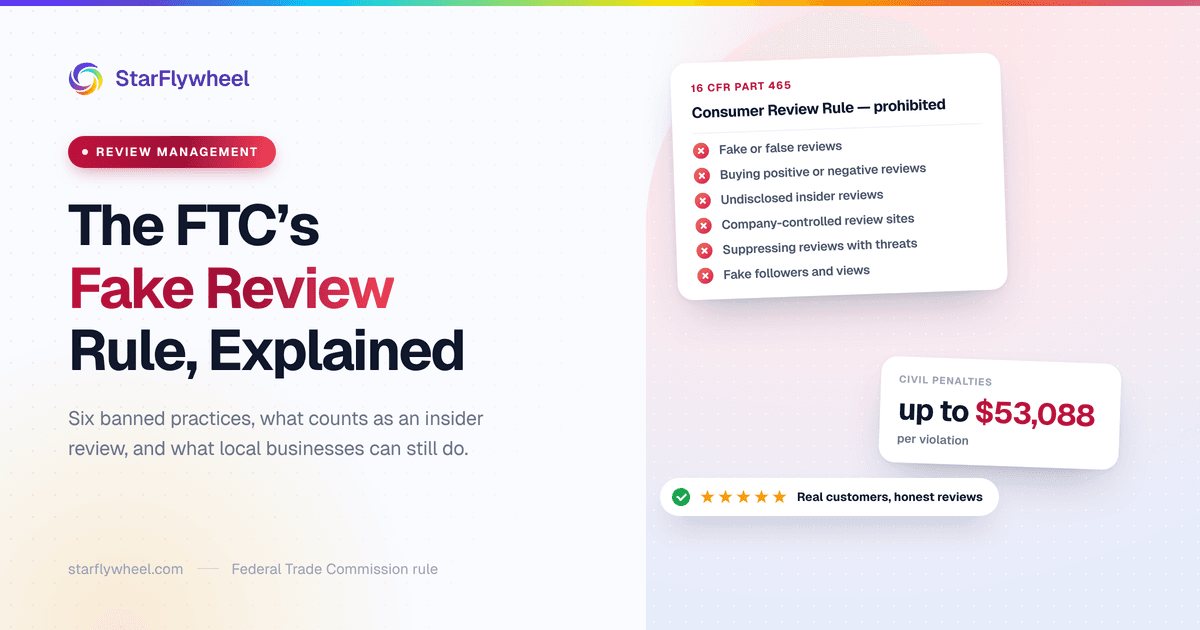
The Six Prohibited Practices
The FTC's press release lists six categories. Here they are in plain words, with the FTC's language where it matters.
1. Fake or false reviews and testimonials
Reviews by people who do not exist, by people who never used the business, or that misrepresent the reviewer's experience. Businesses may not create or sell them. They also may not buy them, get them from insiders, or publish them when they knew or should have known they were fake. That last part matters: "I didn't write them, the agency did" is not a defense if you should have known.
2. Buying positive or negative reviews
The rule bars offering compensation or other incentives "conditioned on the writing of consumer reviews expressing a particular sentiment, either positive or negative." "Ten dollars off for a five-star review" is the textbook case. So is paying someone to post negative reviews about a competitor.
3. Undisclosed insider reviews
The rule "prohibits certain reviews and testimonials written by company insiders that fail to clearly and conspicuously disclose the giver's material connection to the business." We cover what that means for owners, employees and family in the next section, because it is the one most small businesses trip over.
4. Company-controlled review websites
A business may not misrepresent that a website or entity it controls "provides independent reviews or opinions" about a category that includes its own products or services. A "Best Plumbers in Tampa" site that is secretly run by one of the plumbers is exactly what this targets.
5. Review suppression
The rule "prohibits a business from using unfounded or groundless legal threats, physical threats, intimidation, or certain false public accusations to prevent or remove a negative consumer review." It also bars a business from claiming that the reviews on its own website represent all or most of the reviews submitted when it has suppressed reviews based on their rating or negative sentiment.
6. Fake social media indicators
Buying or selling "fake indicators of social media influence, such as followers or views generated by a bot or hijacked account," when the buyer knew or should have known they were fake and uses them to misrepresent influence for a commercial purpose. Less relevant to most local businesses, but worth knowing if someone offers to "boost" your page.
Insider Reviews: Owners, Managers, Employees and Family
This is where good intentions get small businesses into trouble. Opening week, the owner asks a brother-in-law and three employees to leave reviews to get the profile started. It feels harmless. Under the FTC rule, it needs care.
The press release says the rule prohibits undisclosed insider reviews, "prohibits such reviews and testimonials given by officers or managers," and "imposes requirements when officers or managers solicit consumer reviews from their own immediate relatives or from employees or agents." The FTC's Q&A answers the family question directly: can a small business owner ask family members to post reviews? "Yes, but ask them to clearly and conspicuously disclose their relationship to your business."
In practice:
- Owners and managers: do not review your own business. Undisclosed reviews by officers or managers are exactly what the rule names.
- Family: if they review, the review must clearly say they are related to you. Many owners find it simpler to ask them not to.
- Employees: same disclosure requirement. Never ask staff to post reviews, and never send them the review link as a task.
The FTC also addresses a common worry: you email a review request to all recent customers, and one of them happens to be an employee who posts without disclosing. The Q&A says that alone is not a violation, because the rule carves out "generalized solicitations to purchasers." It also says officers and managers are not expected to "scour every review," but that red flags — a reviewer sharing your last name, an employee who was sent the link — should prompt follow-up.
Disclosure is what the FTC asks for, but Google's contribution policy goes further: it prohibits content based on a conflict of interest, which it says may include current or former employment and family ties. The cleanest policy for a small business: owners, staff and family do not review the business.
Review Suppression: Threats Are Out, Reporting Is Fine
When a harsh review lands, the temptation is to make it go away. The rule draws the line at threats and intimidation: no threatening to sue over an honest negative review, no pressuring the customer, no falsely accusing them in public of being a competitor or a fraud to get the review taken down.
What the rule does not stop is the normal toolkit:
- Responding publicly, calmly and specifically. Our guide to responding to negative reviews has templates.
- Reporting genuinely fake reviews to the platform. On your own website, the Q&A says you may refuse reviews that are "patently false," such as reviews of the wrong business. On Google, use Google's reporting process — our guide on how to remove fake Google reviews walks through it.
- Reasonable moderation rules on your own site, as long as they treat positive and negative reviews the same way.
If a review is genuinely defamatory, that is a question for a lawyer — not a threat to fire off yourself.
What Is Still Fine
None of this makes asking for reviews risky. The rule targets fake, bought, hidden and suppressed reviews — not honest ones. You can still:
- Ask every customer for an honest review, by email, text, QR code or in person.
- Send the same request to everyone on your customer list — exactly the "generalized solicitation" the rule carves out.
- Respond to reviews, positive and negative.
- Report fake reviews through each platform's process.
- Share real reviews on your website and marketing, as long as you do not misrepresent them.
Two practices sit in a gray zone under the FTC rule and are flatly banned by Google, so treat them as off-limits:
- Incentives for "any honest review." The Q&A says the rule itself "does not prohibit giving incentives for reviews" if there is no requirement for a particular sentiment — but failing to disclose the incentive can still violate the FTC Act. Google prohibits incentives for any review, full stop.
- Review gating (asking only happy customers). The Q&A says the rule does not specifically prohibit it, but that the practice "could violate the FTC Act." Google prohibits it outright.
Enforcement: Warning Letters and Penalties
The rule lets the FTC seek civil penalties against knowing violators. On December 22, 2025, the FTC announced warning letters to 10 companies about possible violations of the rule. The announcement did not say which practices each letter cited; it reminded businesses of the rule's main prohibitions, from fake reviews and sentiment-conditioned rewards to undisclosed insider reviews, company-run review sites, review suppression and fake social media indicators. The FTC noted the letters are not findings that any company broke the rule, and it did not name the recipients. FoodNavigator reported on the letters in January 2026 as a signal of a broader crackdown.
The December announcement says violations can bring civil penalties of up to $53,088 per violation. That is the current inflation-adjusted maximum for rule violations listed in 16 CFR 1.98, set in the FTC's 2025 adjustment. The figure is adjusted periodically, so check the current number if it matters to you. "Per violation" is the important phrase: twenty fake reviews is not one violation.
How the FTC Rule and Google's Policy Fit Together
They overlap but are not the same. The FTC rule is US law about deceptive practices. Google's contribution policy is the platform's own rulebook, and in several places it is stricter. Our guide to Google's review rules in 2026 covers it in detail.
| Practice | FTC rule | Google policy |
|---|---|---|
| Writing or buying fake reviews | Prohibited | Prohibited |
| Incentive for a positive review | Prohibited | Prohibited |
| Incentive for "any honest review" | Not banned by the rule; disclosure issues under the FTC Act | Prohibited |
| Asking only happy customers (gating) | Not specifically banned; "could violate the FTC Act" | Prohibited |
| Undisclosed reviews by staff or family | Prohibited | Prohibited (conflict of interest) |
| Asking customers to mention a staff member | Not addressed | Prohibited |
| Review quotas for staff | Not addressed | Prohibited |
| Threatening reviewers | Prohibited | — |
The practical takeaway: if you follow Google's rules for how you ask, and nobody connected to the business writes reviews, you are clear of the FTC rule's main traps for a local business. Yelp is stricter still — it discourages asking for reviews at all. Our Yelp guide explains what is allowed there.
Do and Don't: A Small Business Cheat Sheet
| Do | Don't |
|---|---|
| Ask every customer for an honest review, the same way | Ask only customers you think are happy |
| Send one neutral message with one link | Offer discounts, gifts or raffle entries for reviews |
| Let reviews come from real customers | Write reviews yourself, or ask staff or family to |
| Require disclosure if a relative does review | Buy reviews or hire anyone who "provides" them |
| Respond publicly and calmly to criticism | Threaten legal action over an honest negative review |
| Report fake reviews through the platform | Pay someone to post negative reviews about competitors |
| Show real reviews on your website | Run a "review site" you secretly control |
| Talk to a lawyer about a defamatory review | Buy followers or views to look bigger |
Where StarFlywheel Fits
StarFlywheel is built for the generalized solicitation: a campaign sends the same request and the same review link to every customer you enroll, by email or text, with no satisfaction screen in front of the link. The default template asks customers about their experience and links to the review page — no incentives, no suggested wording. The templates are yours to edit, so keep them neutral. Our review request templates give you compliant wording to start from.
Honest reviews from real customers take longer than buying fifty. They are also the only kind that cannot get you fined.
Build your reviews the honest way
StarFlywheel sends your customers to the review platforms that matter to you and tracks your Google reviews automatically — free to start, paid plans from $9/month.
Ready to grow your reviews?
Start building your review flywheel today. Free plan available, no credit card required.
Start Free