

Google's Review Rules in 2026: What Changed and What to Stop Doing
Google's review policy now bars asking customers to name staff, scripting review content, and staff review quotas. What the rules say, before-and-after review requests, what happens if you break them, and a compliance checklist.
The Short Version
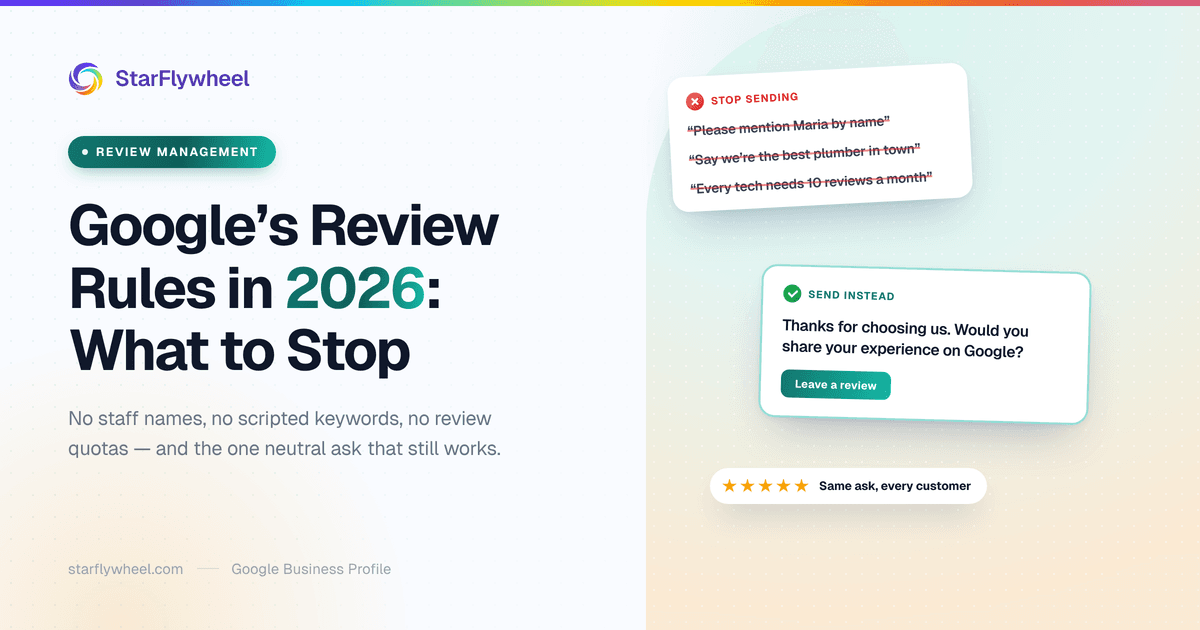
Google's rules for how businesses ask for reviews got stricter in 2026, and a lot of perfectly ordinary habits are now on the wrong side of them. Asking customers to mention the technician by name. Suggesting they call you "the best plumber in Orlando." Giving each tech a monthly review target. None of that felt like cheating to most owners. All of it now conflicts with Google's published policy.
Below: what the policy says, quoted from Google's own pages, and what to do instead. The compliant way to ask is also the simplest — one neutral question, one link, the same for every customer.
This is a plain-language summary of Google's published policies, not legal advice. For a specific situation — a dispute, a restricted profile, an agency contract — talk to a lawyer.
Where the Rules Live
Google's rules for reviews on Maps and Business Profiles sit in its contribution policy for Maps, on the page covering prohibited and restricted content. Two sections matter for anyone asking customers for reviews: Fake engagement and Rating manipulation. The page carries no visible "last updated" date, so reread it every few months rather than relying on a summary — including this one.
The rating manipulation section opens bluntly: "Rating Manipulation includes Incentivized or Biased Reviews, which are not allowed and will be removed from Maps."
What Google Says Merchants Must Not Do
Here are the five rules that cover how a business asks for reviews, with Google's wording.
1. No incentives of any kind
Google prohibits "content that has been posted due to an incentive offered by a business," and its fake engagement section lists "reviews or ratings that have been paid for, directly or in kind." Merchants also may not offer incentives "in exchange for posting any review or revision or removal of a negative review."
No discount, no free dessert, no prize draw, no gift card — even if you would give it for a negative review too. Any incentive for any review is out.
2. No gating
Merchants may not "discourage or prohibit negative reviews, or selectively solicit positive reviews from customers." This is what the industry calls review gating: you ask "How did we do?" first, send the happy customers to Google, and route everyone else to a private form.
If a tool's pitch is built on filtering customers by satisfaction before they ever see your Google link, that is a reason to walk away.
3. No requesting specific content — including staff names
Google's policy says merchants may not ask for "reviews that include specific content," and it calls out content that identifies a staff member specifically. This is the rule most businesses were breaking without realizing it.
It covers more than names. Asking customers to mention a particular service, a keyword, your city, or a phrase like "fast and affordable" is requesting specific content too.
4. No staff review quotas
The policy lists "merchants requesting that staff solicit a certain number of reviews" as not allowed. "Ten reviews per tech per month" is a quota. A leaderboard, a contest, or a bonus tied to review counts works the same way in practice. Google has not spelled out where every bonus scheme falls, so the safe reading is to keep review numbers out of individual pay and recognition altogether.
5. No pressure on the premises
When soliciting reviews, merchants "should not require or pressure users to leave ratings or write reviews while on the premises." This does not ban asking in person. A technician who says, at the end of a job, "If you have a minute later, we'd appreciate an honest review on Google," is fine. Handing someone a tablet and waiting while they type is not. Neither is making a review a condition of anything — finishing checkout, getting the receipt, being seated.
Underneath all five, the fake engagement section bars asking people to post "content that does not represent a genuine experience." Reviews should come from real customers, in their own words.
What Changed in 2026
What drew the most attention this year was the language on staff and specific content. Mainstreethost reported in April 2026 that Google's update barred businesses from requiring employees to collect a specific number of reviews, from requesting or influencing reviews that identify individual staff members, and from encouraging specific phrasing. Storagepug's write-up of the 2026 update describes the same three areas — quotas, specific content such as staff names, amenities or keywords, and pressure.
Google does not publish a dated changelog on the policy page, so treat the timing as reported rather than confirmed. The current text is what counts, and it is clear.
Why the staff-name rule stung
For trades, salons, dental practices and driving schools, "mention your technician by name" was standard advice — including from review software vendors. But a profile full of prompted names reads like a campaign rather than customers, and Google now says so explicitly.
Reviews that name a staff member unprompted are still welcome — thank them, quote them, share them. Just don't ask for them.
Before and After: Rewriting Your Review Requests
Here are the requests we see most often, and what to send instead.
Naming staff
Before: "Thanks for choosing us! If you loved your visit, please mention Maria by name in your Google review."
After: "Thanks for choosing us. Would you share your experience on Google? [link]"
If Maria was great, many customers will name her without being asked — and those reviews read as real because nobody prompted them.
Scripting keywords
Before: "It would mean a lot if you said we're the best plumber in Orlando!"
After: "Thanks for having us out on Tuesday. If you have a minute, we'd appreciate an honest review on Google: [link]"
The job and the date are context, not content: you remind them what happened, not what to write.
Quotas for the team
Before: "Every tech needs 10 reviews a month. Top collector gets a $100 bonus."
After: "Every tech asks every customer the same question at the end of every job." Track asks and reviews for the business as a whole, never per person.
Asking only the happy ones
Before: "How would you rate us, 1 to 5? [5 stars → Google link] [1–4 stars → 'Tell us privately how we can improve']"
After: "Would you share your experience on Google? [link]" — sent to everyone. If you also want private feedback, ask for it separately and give everyone the same Google link regardless of how they answer.
Incentives
Before: "Leave us a review and get 10% off your next visit!"
After: No offer at all. Not for positive reviews, not for "any honest review," not as a raffle entry.
Pressure at the counter
Before: Handing over a tablet open to the review form: "Would you mind doing it now, before you go?"
After: A QR code on the counter or the receipt and a one-line ask: "If you have a minute later, we'd love an honest review." Let them do it on their own time. Our guide to Google review QR codes covers placement that invites rather than pushes.
The Neutral Ask, Spelled Out
A compliant review request has four properties:
- Everyone gets it. Every customer, regardless of how the visit went or how you think they feel.
- It asks for an honest review, nothing more. No suggested wording, no names, no services, no cities.
- It carries one link. Straight to your Google review form, with no satisfaction screen in front of it.
- It comes with nothing attached. No incentive, no condition, no deadline, no pressure.
That is it. For wording and timing that still feels warm, see our review request templates and our guide to the best way to ask customers for reviews. If you run a trades business, our home services guide covers how to train technicians to ask without naming anyone.
Customers Can Report Your Conduct
Google Maps gives customers a direct way to report a business's review practices, not just individual reviews. According to Google's help page on reporting a business, a user opens your place on Maps, chooses Suggest an edit, then selects Report business conduct at the bottom of the page. The Report business conduct form lets them flag that a business may be "offering something in exchange for reviews" or "pressuring people to leave reviews," say where they saw it — in store, on social media, on your website, in a private message — and attach screenshots.
So a sign at the register offering a discount for reviews is one photo away from a report. The same form works in your favor if a competitor is openly buying reviews.
What Happens If You Break the Rules
Google is specific about some consequences and deliberately vague about others. Here is only what it states.
- Review removal. The contribution policy says incentivized or biased reviews "will be removed from Maps."
- Profile restrictions. Google's page on Business Profile restrictions for policy violations says that, in addition to removing violating reviews, Google may stop a profile from receiving new reviews or ratings "for set period of time," unpublish its existing reviews or ratings for a set period, and display a warning letting consumers know that fake reviews were removed. The page gives no specific duration. Businesses can appeal.
- Account action. The contribution policy also says Google may take actions ranging "from suspending the account privileges to account termination" for harmful behavior.
And Google's rules are not the only ones in play. In the US, the FTC's rule on fake reviews applies to the same conduct from a different direction — buying reviews, undisclosed insider reviews, suppressing negative ones. Our guide to the FTC's fake review rule covers what it prohibits and what the penalties are.
When Someone Uses Reviews Against You: Extortion
The flip side of review manipulation is review extortion: a sudden wave of 1- and 2-star reviews, followed by a message demanding payment to make them go away. Google's guidance on review extortion scams calls this "a serious policy violation" and is direct about what to do:
- Do not pay or engage. Google says not to "try to resolve it yourself by offering money or services."
- Gather all evidence immediately. Screenshots of every demand, showing the date, time and the sender's contact details where possible.
- Collect direct links to every review you believe is part of the attempt.
- Report it through the merchant extortion report form linked from that page. Google says its team investigates and notifies you of the result, without sharing investigation details.
That form is only for cases where someone has actually demanded money or favors. Ordinary fake or off-topic reviews go through the normal reporting route — our guide on how to remove fake Google reviews walks through it. If the threats are serious or involve personal safety, contact law enforcement and a lawyer as well.
How StarFlywheel Fits
A StarFlywheel campaign sends the same message and the same review link to every customer you enroll, and new customers can be enrolled automatically, so nobody is left out because they seemed grumpy at checkout. There is no satisfaction screen in front of the link.
The default campaign template reads: "We'd love to hear about your experience at [your business]. Please leave us a review:" followed by the link. No staff names, no suggested phrasing. Templates are editable, so the rule is on you once you change them: write your template neutrally, and do not add a line asking customers to mention anyone or anything.
If you use segments (Growth plan), base them on facts like when a customer was added or a tag you set, never on how satisfied someone seemed.
Compliance Checklist
Run through this whenever you change a template, a sign, or a staff incentive.
- Every customer gets the same review request, whatever you think of their visit.
- Your request asks for an honest review and contains no suggested wording.
- No template, sign, card or script asks customers to mention a staff member.
- No template asks customers to mention a service, product, keyword or city.
- The review link goes straight to Google, with no "rate us first" screen.
- No discount, gift, raffle entry or freebie is tied to leaving or changing a review.
- No employee has a review target, and no leaderboard, contest or bonus is tied to review counts.
- Nobody is asked to write a review on the spot, and no review is a condition of service.
- Owners, staff and their families do not review the business.
- You never offer anything to get a negative review changed or removed.
- Staff know what to do if someone demands money to remove reviews: do not pay, save everything, report it.
- Reviews that name staff on their own are thanked and celebrated — not requested.
None of this slows down a healthy review program. Ask everyone, every time, and let customers say what they actually think.
Ask every customer the same way, automatically
StarFlywheel sends your customers to the review platforms that matter to you and tracks your Google reviews automatically — free to start, paid plans from $9/month.
Ready to grow your reviews?
Start building your review flywheel today. Free plan available, no credit card required.
Start Free