

How Google Reviews Show Up in AI Search (and What You Can Actually Control)
How Google Maps, AI Overviews, AI Mode and assistants like ChatGPT use your reviews — what Google has actually said, and the honest things a local business can do about it.
A New Kind of Search Result
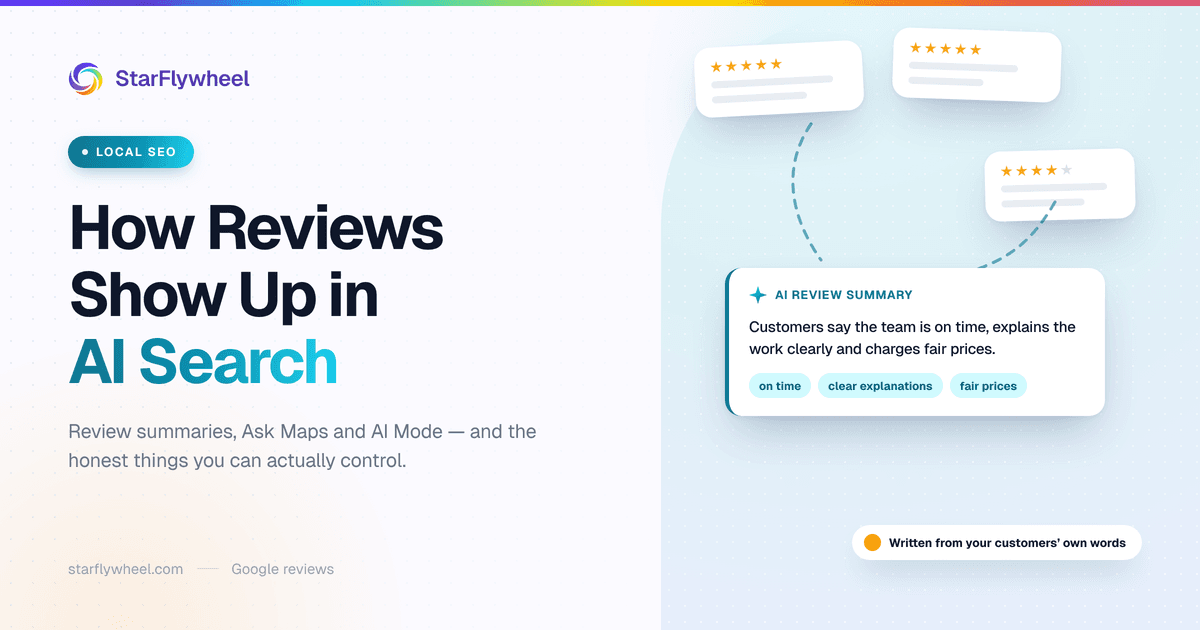
Ask Google Maps for "a quiet coffee shop to work from near me" and you may no longer get a plain list of pins. Increasingly you get an answer: a few places, a sentence about why each one fits, and a line pulled from what customers have said about them. Ask ChatGPT or Perplexity the same question and you get something similar, with links to the sites it read.
For a local business owner this raises an obvious and slightly anxious question: what is the AI reading about me, and can I do anything about it? The short answer is that it reads a lot of what your customers have written — reviews above all — and that you have real but limited influence over it. The long answer is this article.
We will go through what Google itself has said about how reviews feed its AI features, what is known (and what is only reported) about other AI assistants, and the short list of things an owner can honestly do. We will also be blunt about one thing up front: nobody can make an AI recommend your business. Anyone selling that is selling nothing.
What Google Has Actually Said
There is a lot of speculation about AI search. To keep this useful, everything in this section comes from Google's own announcements and documentation, linked so you can read them yourself.
Review summaries in Google Maps
In October 2024 Google announced that Gemini was coming to Google Maps. The announcement on Google's blog described two things that matter to owners: you could ask Maps questions about a place — whether it has outdoor seating, whether it is quiet — and you could read a review summary written by Gemini to see what people like about it. Google said those answers were grounded in its data on places and in insights from the Maps community, and that the features were rolling out in the US on Android and iOS.
The phrase "insights from the Maps community" is the part to underline. When Maps writes a sentence about your business, the raw material is largely what your customers wrote.
Review summaries for developers
Google also sells this capability to other apps. In September 2025 the Google Maps Platform blog announced that AI-powered summaries of places, areas and reviews were generally available to developers. The review summary, in Google's words, captures the top themes from user reviews and is powered by Gemini. The post listed review summaries as available in the UK, India and Japan as part of a regional expansion.
The practical point: your Google reviews can be summarized not only inside Google's own apps, but inside travel, real estate and booking apps that build on Google's place data. You will not always know where a summary of your business is being shown.
Ask Maps
In March 2026 Google went further. Its post introducing Ask Maps describes a conversational experience that answers complex, real-world questions about places with a custom map. Google says it draws on information about more than 300 million places and on reviews from its community of more than 500 million contributors, and that it started rolling out in the US and India on Android and iOS.
So the trend is clear. The first thing a searcher sees about you is less often your star rating alone and more often a written answer that leans on review text.
AI Overviews and AI Mode in Search
Google Search has two AI features of its own. When Google expanded AI Mode in May 2025, it said that for local spots like restaurants, salons and stores, people could see info like ratings, reviews and opening hours right in the answer, based on Google's information about local businesses.
Google's documentation for site owners, AI features and your website, is refreshingly plain about what it takes to appear: "There are no additional requirements to appear in AI Overviews or AI Mode, nor other special optimizations necessary." Among its few recommendations is checking that your Business Profile information is up to date and that important content on your site is available as text.
Google's broader guide to optimizing for generative AI features says the same thing at more length. You do not need special AI files, markup or Markdown versions of your pages. Optimizing for AI search is still just SEO. And it warns site owners to be wary of third-party tools that promise ranking success, and that creating many variations of content mainly to manipulate rankings or AI responses violates its spam policy on scaled content abuse.
What About ChatGPT, Perplexity and the Rest?
Here the evidence is thinner, and we will say so. These companies publish far less about how they choose local businesses than Google does.
What can be verified: OpenAI's help page on ChatGPT search says answers that use search include inline citations and a list of sources, and that ChatGPT may share search queries with third-party search providers such as Bing. When OpenAI launched ChatGPT search in October 2024, it said it had partnered with data providers for categories including maps, and that any website can choose to appear in its search results.
Perplexity, according to reporting from March 2024, integrated Yelp data so users could see maps, reviews and photos of local businesses in its answers. That came from press coverage of the deal, not from a technical document, so treat the details as reported rather than confirmed.
Beyond that, much of what circulates about "how ChatGPT picks businesses" comes from marketing firms studying which sites get cited. Their general observation — that AI assistants often cite review sites, directories and local news alongside business websites — is plausible and matches what you see when you try it. But the specific percentages you will find online are not published by the AI companies, and the systems change often. We do not repeat them here.
The reasonable conclusion is modest: AI assistants read the open web, and on the open web your reputation lives mostly in reviews and directory listings. Being consistently, genuinely well reviewed in the places those tools read is the most durable position available.
What You Can Actually Control
None of what follows is a trick. It is the same work that has always helped local businesses get found, which is exactly the point Google's own documentation makes.
1. A steady stream of genuine reviews
Review summaries are built from themes across many reviews. A business with twelve reviews, the newest from 2023, gives a summarizer very little to work with and may get a thin or stale description. A business with a steady flow of recent reviews gives it a current, detailed picture.
Steady matters more than a burst. Ask every customer, the same way, every week, and the volume takes care of itself. Our guide on how to get more Google reviews covers the mechanics, and how many Google reviews you need covers how to set a realistic target.
2. Let customers describe their real experience — don't script it
Here is where many "AI SEO" tips go wrong. It is tempting to think: if the AI reads review text, I will ask customers to mention "emergency plumber" and the name of my town. You cannot do that.
Google's contribution policy says merchants must not request that specific content be included in a review — and that includes content identifying a staff member. Scripted keywords, suggested phrases, "please mention our new location" and "tell them Maria helped you" are all on the wrong side of that line. Our explainer on Google's 2026 review policy goes through each rule.
The good news is you do not need to. If you really do fix water heaters in Springfield, customers who are happy about their water heater will say so in their own words. Asking more customers, more consistently, is what produces more descriptive reviews. The only honest lever on review content is the service itself.
3. Reply to your reviews
Google's own tips for improving your local ranking recommend replying to reviews, noting that it shows you value customer feedback. Replies are also public text attached to your listing that any reader — human or machine — can see.
Write replies for the next customer reading them, not for an algorithm. Thank people specifically, and handle complaints calmly and with a next step. Our guides to responding to positive reviews and responding to negative reviews have templates.
4. Keep your Business Profile accurate and complete
This is the one recommendation that appears in nearly every Google document cited above. Correct categories, the services you actually offer, your service area, your hours (including holiday hours), your phone number, real photos. When AI Mode tells someone whether you are open on Sunday, that answer comes from somewhere — make sure it comes from information you keep current.
The same Google page is also clear that there is no way to request or pay for a better local ranking. Our Google Business Profile optimization guide walks through every field.
5. Be listed consistently where people look
Claim your listings on the directories that matter for your industry — Yelp, Facebook, Apple Maps, Bing Places, and the trade or professional directories specific to your field. Use the same business name, address, phone and website on each. You do not need hundreds of listings; you need the important ones to be accurate and to agree with each other.
This matters for AI assistants for the simple reason that they read more than Google. If ChatGPT pulls from a directory that still shows your old address, that is the address it may repeat. Yelp in particular has its own rules about asking for reviews — our guide to getting more Yelp reviews explains them.
6. Make your own website easy to read
Google's AI documentation recommends making important content available as text. For a local business that means a website where a person — or a program — can quickly find:
- what you do, in plain words, with one clear page per main service;
- where you do it: your address or the towns you serve;
- when you are open and how to reach you;
- prices or price ranges, if you can share them.
Avoid putting that information only inside images, PDFs or a menu photo. And if you show reviews on your site, show real ones with a widget rather than retyped quotes — our guide to embedding Google reviews on your website covers how.
What You Cannot Control
It is worth being just as clear about the limits.
- You cannot choose what the summary says. Google writes it from the reviews. If customers keep mentioning slow service, the summary may too. The fix is the service, then the reviews follow.
- You cannot buy your way in. Google says there is no way to request or pay for a better local ranking. Advertising exists, but it is labeled as advertising; the unpaid answer is not for sale, from Google or from an agency.
- You cannot predict a single answer. AI answers vary by wording, location and person. Ask Maps, for example, personalizes using places someone has searched for or saved. Checking "do I show up in ChatGPT?" once tells you very little.
Be Skeptical of "AI Visibility" Offers
A new industry has appeared promising to get businesses "recommended by ChatGPT" or "into Google's AI answers." Some offer reasonable SEO under a new name. Others offer things that range from useless to harmful.
Here is a quick filter. Walk away from anyone who:
- guarantees that an AI will recommend you — nobody can, and Google explicitly warns against tools that promise ranking success;
- offers to write or "seed" reviews, or to post mentions of your business across forums and fake profiles — that is fake engagement, and fake reviews are illegal under the FTC's rule on consumer reviews;
- wants to generate hundreds of near-identical location or keyword pages for your site — Google treats pages made mainly to manipulate AI answers as spam;
- tells you to ask customers to include particular keywords in their reviews — Google's policy forbids requesting specific content.
If someone is offering to help you keep your profile accurate, fix your listings and set up a consistent way to ask every customer for a review, that is useful work. If they are offering a shortcut, there is not one.
The Bottom Line
AI search does not change what earns a local business a good reputation. It changes how quickly that reputation is summarized and handed to a stranger. The businesses that come out well are the ones with many recent, genuine reviews, accurate listings and a clear website — which were already the businesses that did well on Google Maps.
So the to-do list is short: ask every customer for an honest review, reply to what they write, keep your Business Profile and directory listings accurate, and make your website say plainly what you do and where. Our overview of how reviews affect local SEO in 2026 covers the classic ranking side of the same picture.
Ready to grow your review count?
StarFlywheel sends customers to the review platforms that matter to you and tracks your Google reviews automatically — free to start, paid plans from $9/month.
Ready to grow your reviews?
Start building your review flywheel today. Free plan available, no credit card required.
Start Free