

How Many Google Reviews Do You Need? A Practical Way to Set Your Number
There is no magic number. Benchmark against your own local 3-pack, focus on recent pace over lifetime totals, and turn it into a monthly goal you can actually hit.
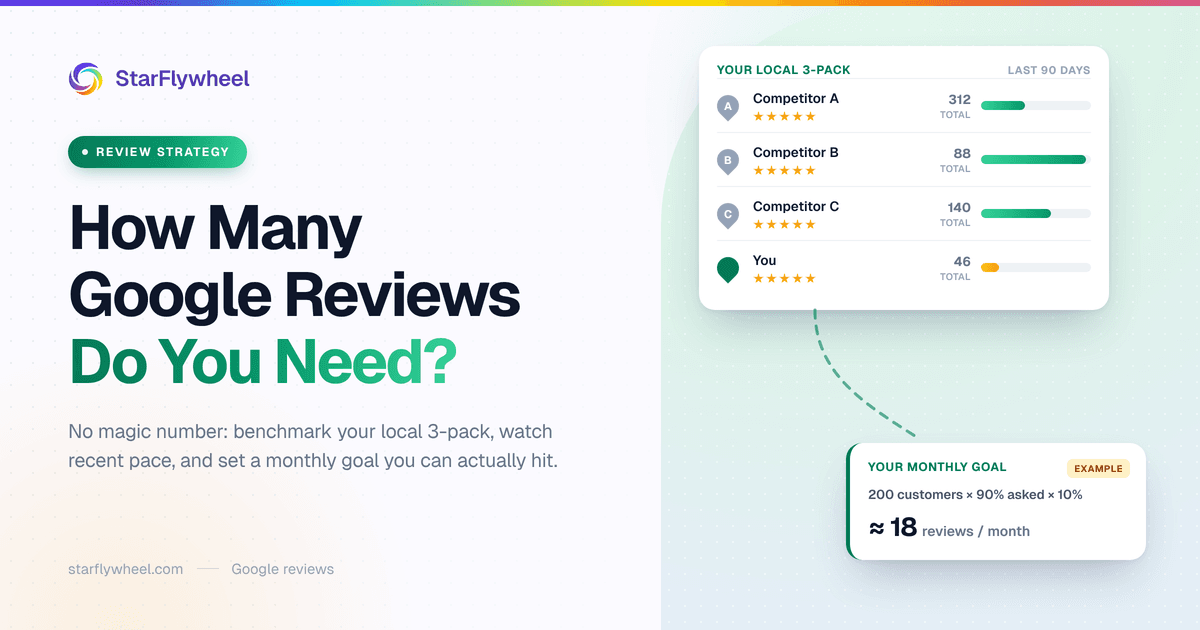
The Honest Answer: It Depends on Who You're Up Against
"How many Google reviews do I need?" is one of the most common questions small business owners ask, and it usually gets one of two bad answers. One is a round number — 50, 100, 200 — with nothing behind it. The other is "as many as possible," which is true and useless.
The real answer is that there is no magic number, because Google does not grade you against a fixed bar. It shows searchers a handful of businesses for a given search in a given place, and you are being compared with those businesses. A florist in a small town with 40 reviews may lead its market. A dentist in a busy city neighborhood with 150 may be at the back of the pack.
So the useful question is narrower: how many reviews do you need to compete with the businesses that show up next to you, and how fast do you need to get them? This article walks through how to find that number, why recent reviews matter more than your lifetime total, and how to turn it into a monthly goal you can actually hit.
What Google Says About Reviews and Ranking
Google is unusually direct on this. Its help page on improving your local ranking says local results are based mainly on three things: relevance (how well your profile matches the search), distance (how far you are from the searcher) and prominence (how well known your business is). It also says that more reviews and positive ratings can help your local ranking.
Notice what that does and does not say. Reviews feed prominence — one of three factors. They do not override distance; no number of reviews will put a business across town in front of a searcher standing next to your competitor. And Google states plainly that there is no way to request or pay for a better local ranking. Our article on how reviews affect local SEO in 2026 goes deeper on the ranking side.
Reviews also matter after the ranking, when a person is deciding whom to call. BrightLocal's 2026 Local Consumer Review Survey found that 41% of consumers "always" read reviews when browsing local businesses. You are not just collecting reviews for an algorithm. You are collecting them for the person reading them.
Step by Step: Benchmark Against Your Own Local 3-Pack
The "local 3-pack" is the block of three businesses with a map that Google shows at the top of many local searches. Those three are your real benchmark. Here is how to measure them in about twenty minutes.
1. Pick your main search
Write down the search a new customer is most likely to type: "plumber near me," "dentist in Coral Gables," "nail salon Bayamón." If you have two very different services, pick the one that brings in the most revenue. You can repeat the exercise for a second search later.
2. Search the way a customer would
Use a private or incognito browser window so your own history does not skew the results, and search from where your customers are — your shop, or the middle of your service area. Results change with location, so a search from your home across town may show you different competitors.
3. Record the three businesses
For each of the three, open the Business Profile and write down:
- the star rating;
- the total number of reviews;
- how many reviews arrived in the last 90 days (sort reviews by "Newest" and count back);
- the date of the most recent review;
- whether the owner replies to reviews.
Do the same for your own profile on the same day.
4. Read the table, not just the totals
Now compare. A simple sheet might look like this — the businesses and numbers here are made up for illustration:
| Business | Rating | Total reviews | Last 90 days | Newest review |
|---|---|---|---|---|
| Competitor A | 4.8 | 312 | 9 | 3 weeks ago |
| Competitor B | 4.6 | 88 | 21 | 2 days ago |
| Competitor C | 4.7 | 140 | 14 | 1 week ago |
| You | 4.7 | 46 | 3 | 2 months ago |
In this example the headline gap looks enormous — 46 against 312. But the more telling column is the last 90 days. Competitor A built its total years ago and is now collecting about three a month. Competitor B is adding seven a month. If you can reach a similar recent pace, you are competing on the number that is moving, not the one that is frozen.
Why Recency and Pace Beat a Lifetime Total
A lifetime total is a record of the past. A reader scrolling your profile sees the dates on the reviews, and a business whose newest review is eight months old raises a quiet question: is it still open, and is it still good? Recent reviews answer that question for you.
There is also a simple practical reason. You cannot change your total quickly, but you can change your pace next month. A steady flow — a few new reviews every week — keeps your profile current, gives Google and its AI summaries fresh material, and adds up over a year to more than most bursts ever do. BrightLocal's survey also asks how recent reviews need to be for consumers to trust them; the short version is that fresher is better.
That is why the goal in this article is a monthly number, not a lifetime one.
The Rating Threshold
Volume is half the picture; the average is the other half. The same BrightLocal 2026 survey found that 31% of consumers will only use a business rated 4.5 stars or higher. For a meaningful share of readers, the gap between 4.4 and 4.5 is the gap between being considered and being skipped.
Two things follow from this:
- More reviews make your rating more stable. With 15 reviews, one angry one-star moves your average noticeably. With 150, it barely registers. Volume is the honest way to protect a rating.
- You cannot filter your way to a higher one. Sending only happy customers to Google and steering unhappy ones elsewhere is called review gating, and Google's contribution policy forbids it. Ask everyone the same way; fix what the critical reviews point at; respond well. Our guide on responding to negative reviews covers that last part.
Turning Your Benchmark Into a Monthly Goal
Once you know the pace you want, work backwards from your customers. The formula is simple:
Customers per month × share you actually ask × share who leave a review = reviews per month
The first number you know. The second you control. The third depends on your industry, your customers and how you ask — there is no reliable universal figure, so do not trust anyone who quotes you one. Start with a cautious guess, run it for a month, and replace the guess with your own result.
A worked example (hypothetical numbers)
The table below is a calculator, not a statistic. Every number in it is invented to show how the math works; the response rates in particular are placeholders you should replace with your own.
| Scenario | Customers / month | Share asked | Customers asked | Assumed response | Reviews / month |
|---|---|---|---|---|---|
| Small salon, asks at checkout sometimes | 200 | 25% | 50 | 10% | 5 |
| Same salon, asks every client + follow-up text | 200 | 90% | 180 | 10% | 18 |
| Plumbing company, 2 trucks | 120 | 80% | 96 | 8% | ~8 |
| Busy restaurant, QR on the check only | 2,000 | 30% | 600 | 2% | 12 |
Look at the first two rows. Nothing about the customers changed — the salon simply started asking everyone. In most businesses, the share asked is the biggest lever you have, and it is the one fully under your control.
Back to the benchmark example: if Competitor B adds about seven reviews a month, a realistic goal for "You" might be seven to ten a month. Plug your own customer count into the formula and see what share of customers you would need to ask to get there.
Set Goals for Asking, Not Quotas for Staff
Once you have a number, there is a natural temptation to hand it to your team: "Everyone needs five reviews this month." Don't.
Google's 2026 policy update, covered in detail here, explicitly bars merchants from asking staff to solicit a certain number of reviews. That rules out per-employee review targets, leaderboards, contests and bonuses tied to review counts. It also bars asking customers to include specific content, such as the name of the employee who served them.
What you can do is measure the process. Track, for the business as a whole:
- how many customers were asked this week (your input);
- how many reviews came in (your outcome).
If asking drops, that is a process problem to fix — a missing step at checkout, a follow-up text that was switched off. And when a review praises someone by name on its own, share it with the team. That is recognition, not a quota. Our guide to the best way to ask customers for reviews covers wording and timing that stay within the rules.
What If a Competitor Has 10x Your Reviews?
It happens, especially against a business that has been around for fifteen years. Before you despair:
- Check their recent pace. As in the example above, a big total often hides a slow present. Your goal is to match or beat their last 90 days, which is far more achievable.
- Remember distance and relevance. Reviews are one part of prominence, which is one of three factors. A complete, accurate profile with the right categories and services, close to the searcher, can still win searches against a bigger total. Our Google Business Profile optimization guide covers those fields.
- Look at what their reviews say. Do they reply? Are the newest reviews complaining about something you do well? Readers notice.
- Play the long game. Ten good reviews a month is 120 a year. In two or three years, the gap can close on its own.
- Never take the shortcut. Buying reviews, swapping reviews with other businesses or posting them from friends' accounts is fake engagement under Google's rules and illegal under the FTC's rule on fake reviews. A large total that disappears in a sweep is worse than a small honest one.
A Simple Plan
Run the 3-pack benchmark this week. Write down the last-90-days pace of the three businesses ahead of you, pick a monthly goal in that range, and use the formula to see how many customers you need to ask. Then make asking a routine — every customer, the same neutral question, one link — and check both numbers every Monday.
For the mechanics of asking, start with how to get more Google reviews and our review request templates. And because reviews now feed AI answers too, our piece on how Google reviews show up in AI search explains what that changes and what it doesn't.
Ready to grow your review count?
StarFlywheel sends customers to the review platforms that matter to you and tracks your Google reviews automatically — free to start, paid plans from $9/month.
Ready to grow your reviews?
Start building your review flywheel today. Free plan available, no credit card required.
Start Free