

Birdeye Alternative for Small Business in 2026
An honest comparison of StarFlywheel and Birdeye as of October 2026 — what Birdeye's quote-only, per-location platform includes, what StarFlywheel Growth covers for $49/mo, and who should stay.
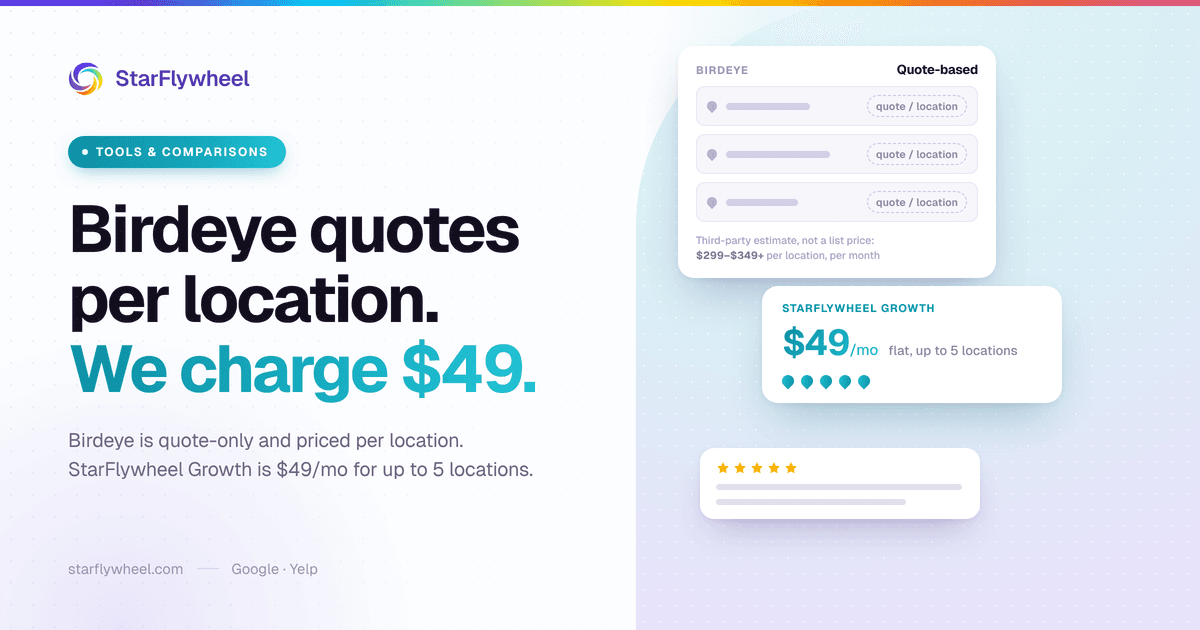
Birdeye Sells a Category. You May Only Need One Product Inside It.
Birdeye does not describe itself as review software. It sells an AI-powered customer experience platform, and that is an accurate description of what you get: reviews, business listings, social media publishing, surveys, messaging, AI agents, and a large integration library. It is a lot of product, and for the multi-location brands it was designed for, it is a lot of product that gets used.
Most people searching for a Birdeye alternative are not unhappy with any of that. They are looking at a subscription reported to start around $299 per location per month, opening a dashboard built for a marketing department they do not have, and clicking through to the same screen as always: reviews.
That is the premise here. If you use the listings sync, the survey builder, and the social scheduler, Birdeye is priced for what it does and switching would cost you working systems. If you bought a customer experience platform because you wanted more Google reviews, you are paying platform prices for a feature.
What follows is a fair comparison, including a section on everything Birdeye does better. If your business lands in that section, we would rather you find out now than three weeks after switching.
What Birdeye Actually Is
Birdeye was founded in 2012 and grew into one of the larger names in local marketing software. Its product has expanded steadily outward from reviews into adjacent categories.
Today the platform spans roughly five areas:
- Reviews: requests, monitoring across a long list of sites, and AI-assisted responses.
- Listings: pushing your name, address, and hours out to directories and keeping them in sync.
- Social: scheduling and publishing posts.
- Surveys and messaging: structured feedback plus webchat and texting.
- Integrations: connections into CRMs, practice management systems, and point-of-sale software.
Birdeye pricing as of October 2026
Birdeye does not publish prices. As of October 2026, its pricing page is a quote form that asks how many locations you have, and the company describes its pricing as custom. Every number below is buyer-reported, not a Birdeye list price:
- Entry tier (formerly called Starter): about $299 to $349 per location per month.
- Middle tier (formerly Growth): about $349 to $599 per location per month, adding social publishing and more AI features.
- Top tier (formerly Dominate): about $449 per location per month and up, adding webchat and advanced analytics.
- Larger accounts: custom quote with volume pricing.
Buyers also commonly report annual contracts that auto-renew, a long written-notice window before renewal, and one-time setup or integration fees on top. Sources: CostBench, WiserReview, and Replio's summary of what Birdeye's site shows. Your quote will depend on your location count and the modules you pick, so treat these as a range, not a promise.
That entry price buys the platform, not a review module, and it deserves to be judged on those terms. As a pure review tool it is expensive. As a system that replaces your review software, your listings service, your social scheduler, and your survey tool, the arithmetic looks entirely different.
Why Owners Go Looking for an Alternative
Four reasons come up repeatedly, and only one of them is a criticism of the software.
$299 a month is a real number for a small business. At the low end of the reported range, that is $3,588 a year for one location, and it is priced per location. It competes directly with a part-time hire, a vehicle wrap, or a full year of local advertising.
The contract changes the math. Annual terms are standard in this part of the market, and buyers report setup costs on top of the subscription. Neither is unusual for enterprise software. But both mean the real first-year commitment is fixed on day one, and a tool you stop opening in month three is one you keep paying for until renewal.
Most of the platform goes unused. Buying a suite and using one module is the most common outcome in small business software. Listings sync matters if you have many locations with drifting hours. Surveys matter if somebody reads them, and social scheduling matters if you post consistently.
Breadth has a cost that never appears on the invoice. Every module you do not use is still on the screen, still in the navigation, still in the onboarding you walk a new hire through. If reviews are the job you are hiring for, a tool that only does reviews is not a compromise. It is the right shape.
StarFlywheel vs Birdeye at a Glance
The full side-by-side lives on our StarFlywheel vs Birdeye comparison page, and the comparison hub covers the rest of the category. The table compares Birdeye's entry tier with StarFlywheel Growth, the plan we would point a Birdeye customer at.
| StarFlywheel Growth | Birdeye entry tier | |
|---|---|---|
| Price | $49/mo for up to 5 locations, or $490/yr | Quote only; about $299+ per location per month reported |
| Free plan / trial | Free plan forever; 7-day trial of paid plans, no card | No free plan |
| Contract | Monthly or annual billing, no setup fee | Annual contract reported |
| Review requests | 1,000 email + 250 SMS per month | Email and SMS campaigns |
| Where requests can send customers | Any platform: Google, Yelp, Facebook, TripAdvisor, OpenTable, a custom link | Google and many other sites |
| Reviews monitored in the dashboard | Google + Yelp, synced weekly | 200+ sites reported |
| AI reply drafts | 30/month, with your brand voice | Yes |
| Website review widget | Yes, 1 domain | Yes |
| Listings management | No | Yes |
| Social media publishing | No | Higher tiers |
| Customer surveys | No | Yes or add-on, depending on tier |
| Integrations | None; CSV import and auto-enrollment | Large library |
Read that table twice. The top half is where the two products overlap. The bottom half is where they stop being the same category of thing.
Why We Compare Growth, Not Our Cheapest Plan
It would be easy to put Birdeye next to our $9 Lite plan and print a 97% saving. That would not be a fair fight. Lite covers one location, monitors Google only on a monthly sync, sends up to 200 emails and 50 texts a month, and has no AI reply drafts.
A business leaving Birdeye usually wants several locations, Yelp alongside Google, and AI help with replies. Growth, at $49 a month, is the plan that matches: up to 5 locations, Google and Yelp reviews pulled in weekly, scheduled campaigns, saved segments, 30 AI reply drafts with your brand voice, weekly summary emails, and PDF reports.
If one location is all you run, Lite or the Free plan may be enough, and every tier is on the pricing page. If you run more than five, Pro covers up to 10 locations for $99 a month.
What StarFlywheel Does Differently
The price, and how it scales. Growth is $49 a month for up to five locations together. Birdeye is reported to price per location, so three locations at the entry tier would land near $900 a month. That is not a claim that you get all of Birdeye; you get the review half, which for most local businesses is the half they open.
A free plan that is not a trial. The Free plan is permanent: one location, Google reviews synced monthly, 25 email requests a month, and a QR code with a printable QR kit, with no credit card. Every paid plan has a 7-day trial with no card, so you can test Growth properly before paying.
No contract and no setup fee. Pay monthly, or annually for the discount. When leaving is easy, the software has to keep earning the money every month.
Setup measured in minutes. Find your business on Google, import your customers from a CSV, pick a template, and start sending. There is no implementation call, because there is not enough product to require one.
One job, done properly. Email and SMS review requests, new customers enrolled automatically, QR codes for the counter and the invoice, and a theme analysis of what customers keep mentioning. Our guide to asking customers for reviews covers timing and wording, and our guide to responding to negative reviews covers the other half of the work. SMS works in the US and Canada and needs your customers' prior consent.
What Birdeye Does Better
Genuinely better, not better-with-an-asterisk.
Listings management. Birdeye pushes your business information out to a network of directories and keeps it consistent. If you have ever found three different closing times on three different sites, this is real work being done for you. We do not do it.
Social media publishing. Scheduling and posting from the same place you manage reviews. We do not post to Facebook, Instagram, or any social network.
Surveys and structured feedback. Reviews tell you what customers say in public. Surveys tell you what they say privately, which is often more specific, and we do not have them.
Integrations. Birdeye connects to CRMs, scheduling systems, practice management, and point-of-sale software. If your review requests need to fire automatically from your system of record, it may already talk to it. We have no integrations today: customers come in by CSV import or are added in the app, which is the most common reason a switch turns out to be a bad idea.
Monitoring breadth. Birdeye monitors far more review sites than we do. We monitor Google on every plan and Yelp on Growth and Pro, on a schedule from monthly to daily, not in real time. You can send customers to any site, but Facebook, OpenTable, and others are not tracked inside StarFlywheel; our breakdown of where your reviews actually matter explains why Google carries most of the weight.
Scale. Our Pro plan tops out at 10 locations, and our AI drafts replies that you paste into Google yourself. At 30 or 100 locations with a marketing team, Birdeye's enterprise tooling is built for you, and we are not. Our guide to multi-location review management covers where that line sits.
Who Should Pick Which
Choose StarFlywheel if you run one to ten locations, reviews are the job you are hiring software to do, a per-location bill is a number you notice, and you would rather be running this week than after an onboarding sequence. The clearest case of all: you already pay for Birdeye, and reviews is the only tab you open.
Stay with Birdeye if your listings genuinely need syncing across directories, somebody on your team publishes social posts or reads survey results, or you depend on an integration into your CRM or scheduling system. Switching would cost you working systems to save money you are not short of.
If you are somewhere in between, our roundup of the best review management software for small business compares the wider field, and our list of the best tools to get more Google reviews focuses on the collection side alone.
The Annual Math
Set against each other over a year, at the low end of reported Birdeye pricing:
- Birdeye, one location: about $299 per month, or $3,588 per year, before setup fees and add-ons.
- StarFlywheel Growth: $49 per month, which is $588 a year paid monthly or $490 paid annually.
- Difference: roughly $3,000 to $3,100 a year for a single location, and it widens with every location you add, because Growth covers up to five for the same price.
The useful way to read this is not as a discount. It is a question about what the extra $3,000 buys inside your business. If the answer is directory sync across twelve locations, that is money well spent; if it is four modules you have never opened, it is a subscription nobody has audited in a while.
How to Switch Without Losing Anything
The fear that keeps owners on an oversized review tool is that leaving will cost them their reviews. It will not, and the reason is worth stating plainly.
Your reviews are not stored in Birdeye. They live on Google, Yelp, Facebook, and the other sites customers used. Birdeye reads them from those platforms and shows them to you. Close your account and your Google reviews stay exactly where they were, visible to customers and counting toward your local ranking; our piece on why reviews matter for local SEO covers what that signal is made of.
A sane sequence:
- Run both for a couple of weeks. Start on our Free plan or a Growth trial, add your business, and send real requests while Birdeye is still live. Nothing conflicts.
- Audit what you would lose. Open every module once and write down which ones did real work this quarter. This is the entire decision, and it takes twenty minutes.
- Solve listings before you cancel, not after. If Birdeye keeps your directory information consistent, that job does not disappear with the subscription. Update the main directories by hand, starting with your Google Business Profile, or keep a dedicated listings service.
- Export what is genuinely yours. Your customer list, with SMS consent records, and any templates worth keeping. Reviews do not need exporting.
- Check your contract date. Find out when the term ends and how much written notice cancellation needs. This is the step people skip and then regret.
- Rebuild the request flow. Usually one email template, one SMS template, and a QR code for the counter or the invoice. An afternoon.
One thing to handle carefully: if review requests currently fire automatically out of your CRM or scheduling system through a Birdeye integration, plan how customers will reach us instead, usually a regular CSV import. That automation is the piece most likely to be doing quiet, real work in the background.
The Honest Summary
Birdeye is not overpriced. It is priced for what it is: a customer experience platform with reviews inside it. The mismatch happens when a business buys the platform and uses the reviews.
If that is you, the fix is not to negotiate a discount on four products you do not open. It is to buy the one you were actually using.
And if the listings sync is the reason your hours are right on every directory in town, ignore all of the above and keep it. That is a real answer too.
Want the review part of Birdeye without the per-location bill?
StarFlywheel sends customers to the review platforms that matter to you and tracks your Google reviews automatically — free to start, paid plans from $9/month. Growth, $49/month, adds scheduled campaigns, segments, Yelp monitoring and up to 5 locations, with a 7-day trial and no card.
Ready to grow your reviews?
Start building your review flywheel today. Free plan available, no credit card required.
Start Free